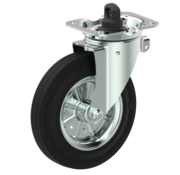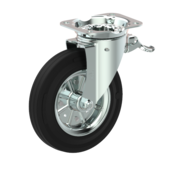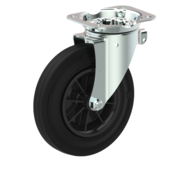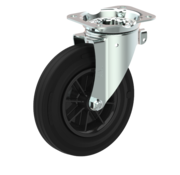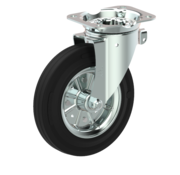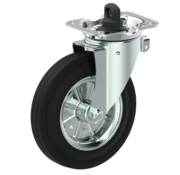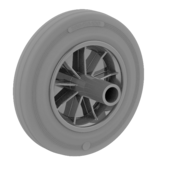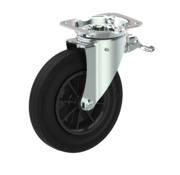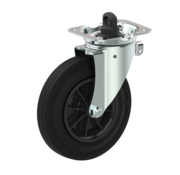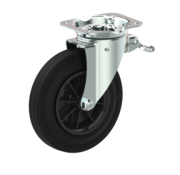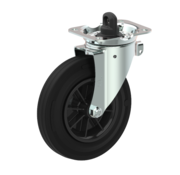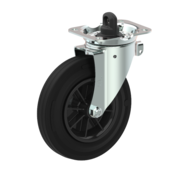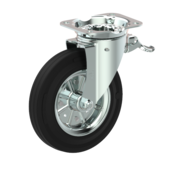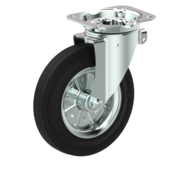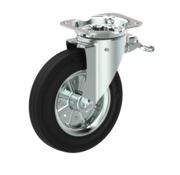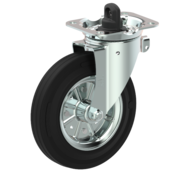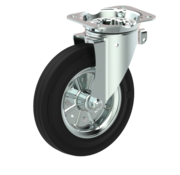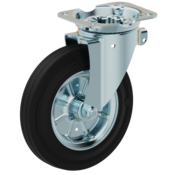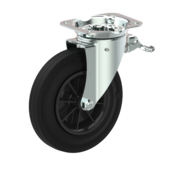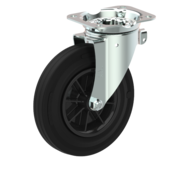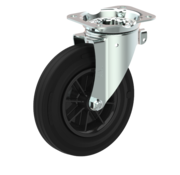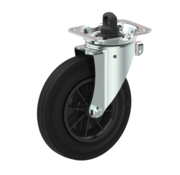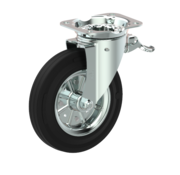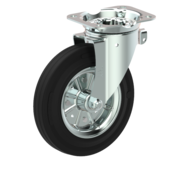

Castors for 4-wheel waste containers, 160 and 200 mm
Swivel castors for 660, 770 and 1100 litre waste containers (wheelie bins): 160 mm for 200 kg and 200 mm for 250 kg per castor, with total brake, central brake or no brake, rubber tyre on a steel rim or PP centre. Made in Postojna, Slovenia.
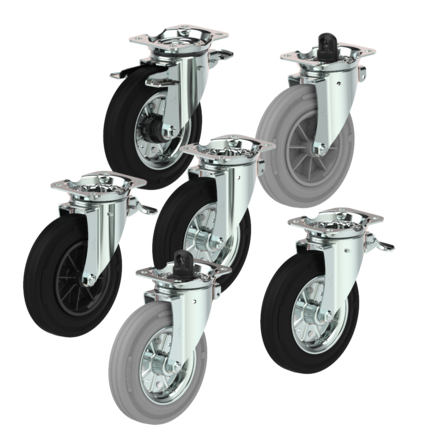
Swivel castors for 660, 770 and 1100 litre waste containers (wheelie bins): 160 mm for 200 kg and 200 mm for 250 kg per castor, with total brake, central brake or no brake, rubber tyre on a steel rim or PP centre. Made in Postojna, Slovenia.
Which castor fits a 1100 litre waste container?
A 4-wheel container of 660 to 1100 litres runs on two swivel castors with brake and two without, or on central brake castors operated from one pedal. The 160 mm castor carries 200 kg per castor at 4 km/h and is the standard on 660 and 770 litre bins; the 200 mm castor carries 250 kg and is the choice for 1100 litre bins that are filled to their 440 kg rated load or that cross kerbs and cobbles daily. Both mount on the 135 x 108 mm top plate with 105 x 80 mm hole spacing and 11 mm bolt holes that container chassis use.
Steel rim or polypropylene centre
All castors on this page run an 80 Shore A black rubber tyre, quiet on asphalt and with grip on wet ramps, from -20 to +70 °C. The tyre sits on a zinc-plated steel rim or on an injection-moulded polypropylene centre. The steel rim takes the lift arm of the collection vehicle and road salt; the polypropylene centre saves about half a kilogram per castor and does not corrode. Plain bearings are standard because the castors stand outside and are pushed by hand; roller bearings are the choice where containers are towed in trains.
What EN 840-5 and RAL-GZ 951/1 require of the castors
EN 840-5 tests the complete container, not the castor alone: filled to 0.4 kg per litre (440 kg for 1100 L) it is driven into a 140 mm kerb at 1.85 m/s eight times, followed by brake and wheel tests. RAL-GZ 951/1, the German quality mark, adds kerb drop and roll tests, a brake test and a wheel run-out check, and limits the noise to 99 dB(A). The castor rating itself comes from EN 12532: load at 4 km/h on a test bench with obstacles of up to 5 % of the wheel diameter. Larger kerbs are usually no problem in daily use, but they lower the dynamic load capacity, which is why 1100 litre bins get the 200 mm wheel. Test references for the container model you build are available on request.
How to identify a replacement castor
Measure the wheel diameter and width, the plate length and width, the distance between the bolt holes in both directions, and note whether the castor has a pedal (total brake), a lever connection to the chassis (central brake) or no brake. With those six figures we match the castor; if the plate pattern differs from 105 x 80 mm, send us a photo of the chassis and we check the fit.
-
Swivel castor with central brake, black rubber tyre Ø160 x 40 mm, 200 kg, plain bearing, steel rim
Braked 160 mm swivel castor for 4-wheel waste containers. 200 kg per castor at 4 km/h (250...
-
-
Swivel castor with brake + black rubber tread Ø200 x W50mm for 350kg
ID 47121: Castor overall height 240 mm | 4 mounting holes with distance 105x80 mm | Wheel ...
-
-
Swivel castor, black rubber tyre Ø200 x 50 mm, 250 kg, roller bearing, PP centre
200 mm swivel castor for 4-wheel waste containers. 250 kg per castor at 4 km/h (310 kg sta...
-
-
Swivel castor, black rubber tyre Ø160 x 40 mm, 200 kg, roller bearing, PP centre
160 mm swivel castor for 4-wheel waste containers. 200 kg per castor at 4 km/h (250 kg sta...
-
-
Swivel castor + black rubber tread Ø200 x W50mm for 350kg
ID 47120: Castor overall height 240 mm | 4 mounting holes with distance 105x80 mm | Wheel ...
-
-
Swivel castor with central brake, black rubber tyre Ø160 x 40 mm, 200 kg, roller bearing, steel rim
Braked 160 mm swivel castor for 4-wheel waste containers. 200 kg per castor at 4 km/h (250...
-
-
Wheel for 2-wheel waste bins, grey rubber tyre Ø200 x 50 mm, 160 kg, 22 mm click-fit hub, PP centre
Wheel for 2-wheel waste bins of 120 to 360 litres. Ø200 x 50 mm, grey non-marking rubber ...
-
-
Swivel castor with total brake, black rubber tyre Ø200 x 50 mm, 250 kg, roller bearing, PP centre
Braked 200 mm swivel castor for 4-wheel waste containers. 250 kg per castor at 4 km/h (310...
-
-
Swivel castor with central brake, black rubber tyre Ø160 x 40 mm, 200 kg, roller bearing, PP centre
Braked 160 mm swivel castor for 4-wheel waste containers. 200 kg per castor at 4 km/h (250...
-
-
Swivel castor with total brake, black rubber tyre Ø160 x 40 mm, 200 kg, plain bearing, PP centre
Braked 160 mm swivel castor for 4-wheel waste containers. 200 kg per castor at 4 km/h (250...
-
-
Swivel castor with central brake, black rubber tyre Ø200 x 50 mm, 250 kg, plain bearing, PP centre
Braked 200 mm swivel castor for 4-wheel waste containers. 250 kg per castor at 4 km/h (310...
-
-
- Short delivery times
-
Swivel castor with central brake, black rubber tyre Ø160 x 40 mm, 200 kg, plain bearing, PP centre
Braked 160 mm swivel castor for 4-wheel waste containers. 200 kg per castor at 4 km/h (250...
-
-
Swivel castor with total brake, black rubber tyre Ø160 x 40 mm, 200 kg, roller bearing, steel rim
Braked 160 mm swivel castor for 4-wheel waste containers. 200 kg per castor at 4 km/h (250...
-
-
Swivel castor, black rubber tyre Ø200 x 50 mm, 250 kg, roller bearing, steel rim
200 mm swivel castor for 4-wheel waste containers. 250 kg per castor at 4 km/h (310 kg sta...
-
-
Swivel castor with total brake, black rubber tyre Ø200 x 50 mm, 250 kg, plain bearing, steel rim
Braked 200 mm swivel castor for 4-wheel waste containers. 250 kg per castor at 4 km/h (310...
-
-
Swivel castor with central brake, black rubber tyre Ø200 x 50 mm, 250 kg, plain bearing, steel rim
Braked 200 mm swivel castor for 4-wheel waste containers. 250 kg per castor at 4 km/h (310...
-
-
Swivel castor, black rubber tyre Ø160 x 40 mm, 200 kg, roller bearing, steel rim
160 mm swivel castor for 4-wheel waste containers. 200 kg per castor at 4 km/h (250 kg sta...
-
-
Swivel castor + black rubber tread Ø200 x W50mm for 250kg
ID 48512: Castor overall height 240 mm | 4 mounting holes with distance 105x80 mm | Wheel ...
-
-
Swivel castor with total brake, black rubber tyre Ø160 x 40 mm, 200 kg, roller bearing, PP centre
Braked 160 mm swivel castor for 4-wheel waste containers. 200 kg per castor at 4 km/h (250...
-
-
Swivel castor, black rubber tyre Ø160 x 40 mm, 200 kg, plain bearing, PP centre
160 mm swivel castor for 4-wheel waste containers. 200 kg per castor at 4 km/h (250 kg sta...
-
-
Swivel castor, black rubber tyre Ø200 x 50 mm, 250 kg, plain bearing, PP centre
200 mm swivel castor for 4-wheel waste containers. 250 kg per castor at 4 km/h (310 kg sta...
-
-
Swivel castor with central brake, black rubber tyre Ø200 x 50 mm, 250 kg, roller bearing, PP centre
Braked 200 mm swivel castor for 4-wheel waste containers. 250 kg per castor at 4 km/h (310...
-
-
Swivel castor, black rubber tyre Ø160 x 40 mm, 200 kg, plain bearing, steel rim
160 mm swivel castor for 4-wheel waste containers. 200 kg per castor at 4 km/h (250 kg sta...
-
-
Swivel castor with total brake, black rubber tyre Ø160 x 40 mm, 200 kg, plain bearing, steel rim
Braked 160 mm swivel castor for 4-wheel waste containers. 200 kg per castor at 4 km/h (250...
-